

Prof. Dr. Günther Grün
Professur für Angewandte Mathematik (Analysis und Numerik partieller Differentialgleichungen)
Professorinnen und Professoren
Adresse
Kontakt
Raum 04.343
Cauerstraße 11
91058 Erlangen
E-mail: gruen@math.fau.de
Telefon: +49 9131 85-67220
Faxnummer: +49 9131 85-67225
Sekretariat:
Cornelia Weber
Lehrstuhl für Angewandte Mathematik (Modellierung und Numerik)
Verwaltungspersonal
Adresse
Kontakt
E-Mail: cornelia.weber@math.fau.de
Um weitere Informationen über die Forschung von Herrn Prof Grün zu erhalten, besuchen Sie die Forschungsinteressen oder Projekte der Arbeitsgruppe Grün.
- Minisymposium „Stochastic free boundary problems“ as part of FBP 2021, Weierstrass Institute for Applied Analysis and Stochastics, Berlin, September 2021 (together with Ana Djurdjevac and Benjamin Gess).
- Workshop Numerical Analysis and Scientific Computing (FAU Erlangen) (together with Michael Fried), Nov. 2019.
- COPDESC-Workshop Calculus of Variation and Nonlinear Partial Differential Equations (Regensburg) (together with G. Dolzmann and H. Garcke), March 2019.
- Section Applied Analysis as part of the Annual Meeting of Society of Applied Mathematics and Mechanics (GAMM) at FAU Erlangen-Nürnberg, March 10th-14th, 2014.
- ITN-Springschool Optimization in pde, reaction-diffusion systems and phase-field models , Saint Raphael, Apr. 7th-12th, 2013, (with D. Hilhorst and G. Leugering).
- ITN-Winterschool Mathematical models for wetting: analysis and numerics, Veilbronn, Feb. 13th-17th, 2012.
- Mini-Symposium Modeling, Analysis, and Simulation of Transport Phenomena in Multi-Phase Flow as part of ICIAM2011, Vancouver, July 18th-22nd, 2011.
- Workshop Phase-Field Models in Fluid Mechanics at Regensburg University, Feb. 14th-16th, 2011 (together with Helmut Abels and Harald Garcke).
- Section Applied Analysis as part of the Annual Meeting of Society of Applied Mathematics and Mechanics (GAMM) at TU Karlsruhe, March, 22nd – 26th, 2010.
- Mini-Symposium Nichtlineare partielle Differentialgleichungen und Anwendungen as part of the Annual Meeting of Deutsche Mathematiker-Vereinigung (DMV) at Erlangen University, September, 19th – 23nd, 2008.
- Mini-Symposium Nonlinear evolution equations and free boundary problems as part of the Annual Meeting of Deutsche Mathematiker-Vereinigung (DMV) at Bonn University, September, 18th – 22nd, 2006.
- Member of Scientific Committee of the Conference Wetting: Theory and Experiment at Technion, Haifa, Israel, July, 3th – 7th, 2005.
- Mini-Symposium Dünne viskose Filme/Thin liquid films as part of the Annual Meeting of Society of Applied Mathematics and Mechanics (GAMM) at TU Dresden, March, 21st – 27th, 2004.
- Mini-Symposium Higher order evolution equations in continuum mechanics as part of ICIAM2003 , Sydney, July, 4th – 11th, 2003.
Current projects
Interfaces, Complex Structures, and Singular Limits in Continuum MechanicsDFG Research Training Group GRK 2339/2Dates: 2022-2027 (second funding period), |
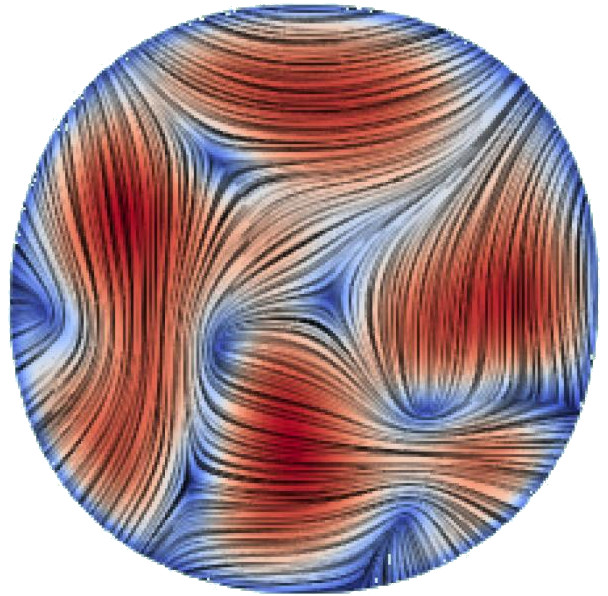 – INTERFACES which separate states of different properties in materials and occur, e.g., in multi-phase flow in fluid dynamics, in fluid-structure interactions in arterial blood flow, as free boundaries in tumour growth or in the macroscopic description of interacting species. – COMPLEX STRUCTURES in porous media, in elastic media with fine-scale structures, or in non-classical fluids, for which the presence of microstructures — like polymers — causes non-standard flow behaviour. – SINGULAR LIMITS related to small length scales in models of continuum mechanics (e.g. elastic plates or rods or thin liquid films) which give rise to dimension reduced models of lower computational complexity. For further information, see
 Completed projects
Interfaces, Complex Structures, and Singular Limits in Continuum MechanicsDFG Research Training Group GRK 2339Dates: 2018-2022 (first funding period), |
 doctorate program of FAU and University of Regensburg in Applied Mathematics. The research focuses on many aspects of advanced mathematical modeling, analysis and numerics with the perspective to understand complex phenomena observed in fluid mechanics, material engineering, biological systems and other applied sciences. Typically interfaces, multiple scales/fields and small parameters (singular limits) are the core features of the problems to be studied. The doctoral program offers a structured course program in partial differential equations, calculus of variations, numerical analysis, scientific computing, mathematical modeling and professional skills. The topics explored in the doctoral projects address:
Free boundary propagation and noise: analysis and numerics of stochastic degenerate parabolic equationsDFG Research Grant
The porous-medium equation and the thin-film equation are prominent examples of nonnegativity preserving degenerate parabolic equations which give rise to free boundary problems with the free boundary at time t > 0 defined as the boundary of the solution’s support at that time. |
Diffusive interface models for transport processes at fluidic interfaces (Part 2)DFG Priority Programme SPP 1056 „Transport processes at fluidic interfaces“ |
||||
|
 In recent years, diffuse interface models turned out to be a promising approach to describe fundamental features of two-phase flow like droplet break-up or coalescence. In the second funding period, novel thermodynamical consistent phase-field models for species transport in two-phase flow shall be derived with an emphasis on soluble surfactants. Additional phenomena — ranging from microscale effects like molecule orientation over thermal effects to electrostatic interactions — shall be included as well. On this basis, new sharp-interface models shall be derived by formal asymptotic analysis.
 For selected diffuse-interface models, existence of solutions and stability of fluidic interfaces will be investigated by rigorous mathematical analysis. Stable numerical schemes shall be formulated and implemented in two and three space dimensions. By numerical simulations, partially guided by the „Leitmassnahme“ Taylor-flow, the models shall be validated and further improved. By numerical analysis, convergence shall be established for the prototypical problem of species transport in two-phase flow with general mass densities.
Fronts and Interfaces in Science and Technology (FIRST) / Marie Curie Initial Training Networks |
||||||
|
 With this network, the universities of Bath, Eindhoven, Erlangen, Haifa (Technion), Madrid (Complutense), Paris (Orsay), Rome (La Sapienza), Zürich and the industrial partners EGIS and SIEMENS AG foster a joint training platform for PhD-students working on analysis and control of interfacial phenomena. Applications range from image processing over reaction-diffusion systems to complex multi-phase flow.
Diffusive interface models for transport processes at fluidic interfaces (Part 1)DFG Priority Programme SPP 1056 „Transport processes at fluid interfaces“ |
||||
Topological transitions like droplet coalescence or droplet break-up are fundamental features of two-phase flows. In recent years, diffuse interface models turned out to be a promising approach to describe such phenomena. Species transport across fluidic interfaces and the effects exerted by soluble and insoluble surfactants are additional issues of still increasing technological importance. |

Mathematical Analysis of Models Describing the Evolution of Liquid Patterns on Material Interfaces (Part 2 and Part 3)DFG Priority Programme SPP 1052 „Benetzung und Strukturbildung an Grenzflächen““ |
||||
|
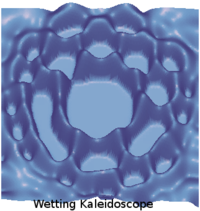 The goal of the project is to analyse, to evaluate, and to improve mathematical models for the dewetting of thin liquid films on homogeneous surfaces and the formation of fluid structures on inhomogeneous substrates. During the second period of the Schwerpunktprogramm, investigations on evaporation and condensation processes will be included. The proposed project consists of three main parts which can be summarized as follows:Modelling: Based on lubrication approximation, evolution equations for the height of condensing fluids on inhomogeneous surfaces shall be derived.Analysis: Methods from the calculus of variations and the theory of partial differential equations shall be used to obtain results on existence and qualitative behaviour of solutions to the corresponding evolution equations for film height h and pressure p. Besides their obvious importance for a better understanding of the asymptotic behaviour of solutions, these theoretical results are also the key ingredient to formulate fast and reliable algorithms for numerical sumulations.Numerical simulations: During the last two years, G. Grün and M. Rumpf succeded in developing and analysing a finite-element/finite-volume scheme which drastically reduces the computation time for the simulation of spreading phenomena. Based on this scheme, a general finite-element solver shall be designed to enable numerical simulations of all the phenomena mentioned above. The evaluation will be performed by comparison with experimental data; it strongly depends on an intense cooperation with experimentalists inside the Schwerpunktprogramm.
DAAD project „Mathematical Analysis and Numerical Simulation of Dynamic Electrowetting“ („projektbezogener Personenaustausch Spanien“) |
||||||
Electric fields may influence the wetting behaviour of charged droplets. This effect may be used to manipulate droplet motion and to enforce droplet coalescence or break-up. It is summarized under the notion of electrowetting. First studied in the late 19th century by Lippmann and others, very recently this effect gained the interest of physicists and engineers on account of a variety of applications in micro-fluidics („lab-on-a-chip“). However, mathematical modeling of this effect is still in its childhood — the dependency of contact angles on the applied voltage is modeled by the so called Lippmann formula which may hold true at most in a small voltage regime. In this project, new thermodynamically consistent models shall be derived to describe the evolution of droplet, voltage and thereby to shed light on the mechanisms underlying electrowetting. Existence of solutions shall be proven and efficient numerical schemes shall be developed as well. Poster>> |
Complex rheologiesProject in SFB 611 „Singular phenomena and scaling in mathematical models“, University of Bonn (together with Christiane Helzel and Felix Otto) |
||
In this project, models for complex flow phenomena are investigated, for instance pattern formation in sheared suspensions, moving contact lines or Rayleigh-Bénard convection. By means of rigorous analysis and numerical simulations, properties of the models will be predicted. The aforementioned specific models may be used to develop new methods for PDE in general.
|
Scaling laws and their cross-overs: global analysis of rheological processesProject in SFB 611 „Singular phenomena and scaling in mathematical models“, University of Bonn (together with Felix Otto) |
||
The goal of this project is to investigate scaling laws in rheological processes. More precisely, analytical tools to rigorously infer such scaling laws shall be developed. A common feature of the friction dominated processes to be investigated is their gradient flow structure. This structure translates the physical free energy and the underlying dissipation mechanism into the mathematical terms of functional and metric tensor, respectively. The idea is to use global PDE methods, rather than local methods, like matched asymptotic expansions, to analyze the scaling laws. Phenomena to be studied include spreading of viscous films, case-II diffusion of solvents in polymeric solids, and the demixing of polymer solutions and sponge-like pattern formation.
|
DFG project „Mathematical Analysis of Models Describing the Evolution of Liquid Patterns on Material Interfaces „)Project in SFB 611 DFG Priority Programme SPP 1052 „Benetzung und Strukturbildung an Grenzflächen“ |
||||
|
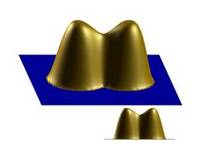 This project is concerned with the analytical description of the qualitative and asymptotic behaviour of solutions to certain higher order parabolic differential equations arising in modelling phenomena of wetting and film rupture. It is planned to develop efficient numerical tools — in particular algorithms based on Finite-Volume-Methods — to enable computer simulations of film rupture in space dimension N = 3.
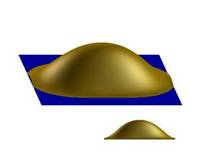 — Part 2: Derivation and analysis of evolution equations to model the formation of liquid structures on inhomogeneous ma- terial interfaces.
- , :
Existence of nonnegative energy-dissipating solutions to a class of stochastic thin-film equations under weak slippage: part I—positive solutions
In: Journal of Evolution Equations 25 (2025), Art.Nr.: 85
ISSN: 1424-3199
DOI: 10.1007/s00028-025-01099-1
BibTeX: Download
- , :
Zero-contact angle solutions to stochastic thin-film equations
In: Journal of Evolution Equations 22 (2022)
ISSN: 1424-3199
DOI: 10.1007/s00028-022-00818-2
BibTeX: Download - , :
Existence of nonnegative solutions to stochastic thin-film equations in two space dimensions
In: Interfaces and Free Boundaries 24 (2022), S. 307-387
ISSN: 1463-9971
DOI: 10.4171/IFB/476
BibTeX: Download
- , , , :
Non-negative Martingale Solutions to the Stochastic Thin-Film Equation with Nonlinear Gradient Noise
In: Archive for Rational Mechanics and Analysis (2021)
ISSN: 0003-9527
DOI: 10.1007/s00205-021-01682-z
BibTeX: Download - , , :
ON STOCHASTIC POROUS-MEDIUM EQUATIONS WITH CRITICAL-GROWTH CONSERVATIVE MULTIPLICATIVE NOISE
In: Discrete and Continuous Dynamical Systems 41 (2021), S. 2829-2871
ISSN: 1078-0947
DOI: 10.3934/dcds.2020388
BibTeX: Download - , :
On the Field-Induced Transport of Magnetic Nanoparticles in Incompressible Flow: Existence of Global Solutions
In: Journal of Mathematical Fluid Mechanics 23 (2021), Art.Nr.: 10
ISSN: 1422-6928
DOI: 10.1007/s00021-020-00523-5
BibTeX: Download
- , :
On the field-induced transport of magnetic nanoparticles in incompressible flow: Modeling and numerics
In: Mathematical Models & Methods in Applied Sciences (2019)
ISSN: 0218-2025
DOI: 10.1142/S0218202519500477
BibTeX: Download
- , :
Existence of positive solutions to stochastic thin-film equations
In: SIAM Journal on Mathematical Analysis 50 (2018), S. 411-455
ISSN: 0036-1410
DOI: 10.1137/16m1098796
BibTeX: Download - , :
Nonnegativity preserving convergent schemes for the stochastic porous-medium equation
In: Mathematics of Computation (2018), S. 1021-1059
ISSN: 0025-5718
DOI: 10.1090/mcom/3372
BibTeX: Download
- , :
Micro-macro-models for two-phase flow of dilute polymeric solutions: macroscopic limit, analysis, numerics
In: Advances in Mathematical Fluid Mechanics, Springer, 2017, S. 291-303 (Transport processes at fluidic interfaces)
BibTeX: Download - , , , :
Diffuse interface models for incompressible two-phase flows with different densities
In: Advances in Mathematical Fluid Mechanics, springer, 2017, S. 203-229 (Transport processes at fluidic interface)
BibTeX: Download
- , , :
On fully decoupled, convergent schemes for diffuse interface models for two-phase flow with general mass densities
In: Communications in Computational Physics 19 (2016), S. 1473-1502
ISSN: 1815-2406
BibTeX: Download - , :
On micro-macro-models for two-phase flow with dilute polymeric solutions -- modeling and analysis
In: Mathematical Models & Methods in Applied Sciences 26 (2016), S. 823-866
ISSN: 0218-2025
DOI: 10.1142/S0218202516500196
BibTeX: Download
- , :
Finite speed of propagation and waiting times for the stochastic porous medium equation -- a unifying approach
In: SIAM Journal on Mathematical Analysis 47 (2015), S. 825-854
ISSN: 0036-1410
BibTeX: Download
- , :
Two-phase flow with mass density contrast: stable schemes for a thermodynamic consistent and frame-indifferent diffuse interface model
In: Journal of Computational Physics 257 (2014), S. 708-725
ISSN: 0021-9991
BibTeX: Download
- :
On convergent schemes for diffuse interface models for two-phase flow of incompressible fluids with general mass densities
In: SIAM Journal on Numerical Analysis 51 (2013), S. 3036-3061
ISSN: 0036-1429
DOI: 10.1137/130908208
BibTeX: Download - , :
On uniqueness results for an elliptic-parabolic system of pde arising in dynamic electrowetting
In: ZAMM - Zeitschrift für angewandte Mathematik und Mechanik 93 (2013), S. 777-788
ISSN: 0044-2267
BibTeX: Download
- , , :
Thermodynamically consistent diffuse interface models for incompressible two-phase flows with different densities
In: Mathematical Models & Methods in Applied Sciences 22 (2012), S. 1150013-1150052
ISSN: 0218-2025
BibTeX: Download - , , :
On modeling and simulation of electrokinetic phenomena in two-phase flow with general mass densities
In: SIAM Journal on Applied Mathematics 72 (2012), S. 1899-1925
ISSN: 0036-1399
BibTeX: Download - , , , :
Numerical simulation of static and dynamic electrowetting
In: Journal of Adhesion Science and Technology 26 (2012), S. 1805-1824
ISSN: 0169-4243
BibTeX: Download
- , , :
On a phase-field model for electrowetting and other electrokinetic phenomena
In: SIAM Journal on Mathematical Analysis 43 (2011), S. 527-563
ISSN: 0036-1410
BibTeX: Download
- , , , , :
A phase-field model for electrowetting
In: Interfaces and Free Boundaries 11 (2009), S. 259-290
ISSN: 1463-9963
DOI: 10.4171/IFB/211
BibTeX: Download
- , , , , :
A phase-field model for electrowetting and related phenomena
In: Proceedings in Applied Mathematics and Mechanics 7 (2007), S. 1151205-1151207
ISSN: 1617-7061
BibTeX: Download
- , :
Lower bounds on waiting time for degenerate parabolic equations and systems
In: Interfaces and Free Boundaries 8 (2006), S. 111-129
ISSN: 1463-9971
BibTeX: Download - , , :
Thin-film flow influenced by thermal noise
In: Journal of Statistical Physics 122 (2006), S. 1261-1291
ISSN: 0022-4715
BibTeX: Download
- , :
The thin-film equation: recent advances and some new perspectives
In: Journal of Physics: Condensed Matter 17 (2005), S. 291-307
ISSN: 0953-8984
DOI: 10.1088/0953-8984/17/9/002
BibTeX: Download
- :
Droplet spreading under weak slippage: existence for the Cauchy problem
In: Communications in Partial Differential Equations (2004), S. 1697-1744
ISSN: 0360-5302
BibTeX: Download - :
Droplet spreading under weak slippage: the waiting time phenomenon
In: Annales de l'Institut Henri Poincaré - Analyse Non Linéaire 21 (2004), S. 255-269
ISSN: 0294-1449
BibTeX: Download - , :
Some remarks on modelling and simulation of thin-film flow
In: Proceedings in Applied Mathematics and Mechanics 4 (2004), S. 47-50
ISSN: 1617-7061
BibTeX: Download
- , , , , , , :
Complex dewetting scenarios captured by thin-film models
In: Nature Materials 2 (2003), S. 59-63
ISSN: 1476-1122
DOI: 10.1038/nmat788
BibTeX: Download - :
Droplet spreading under weak slippage: a basic result on finite speed of propagation
In: SIAM Journal on Mathematical Analysis 34 (2003), S. 992-1006
ISSN: 0036-1410
BibTeX: Download - :
On the convergence of entropy consistent schemes for lubrication type equations in multiple space dimensions
In: Mathematics of Computation 72 (2003), S. 1251-1279
ISSN: 0025-5718
BibTeX: Download - , , , , , :
Correlated dewetting patterns in thin polystyrene films
In: Journal of Physics: Condensed Matter 15 (2003), S. 421-426
ISSN: 0953-8984
BibTeX: Download - , , , , , :
Satellite hole formation during dewetting; experiment and simulation
In: Journal of Physics: Condensed Matter 15 (2003), S. 3355-3366
ISSN: 0953-8984
BibTeX: Download - , , :
Waiting time phenomena for degenerate parabolic equations -- a unifying approach
In: S. Hildebrandt, H. Karcher (Hrsg.): Geometric analysis and nonlinear partial differential equations, Heidelberg: Springer-Verlag, 2003, S. 637-648
BibTeX: Download
- :
Droplet spreading under weak slippage: the optimal asymptotic propagation rate in the multi-dimensional case
In: Interfaces and Free Boundaries 4 (2002), S. 309-323
ISSN: 1463-9971
BibTeX: Download - , , , :
Numerical methods for fourth order nonlinear diffusion problems
In: Applications of Mathematics 47 (2002), S. 517-543
ISSN: 0862-7940
BibTeX: Download - , , :
On space-time adaptive convergent finite element schemes for a general class of lubrication-type equations
In: H.A. Mang, F.G. Rammerstorfer, J. Eberhardsteiner (Hrsg.): Proceedings of the 5th World Congress on Computational Mechanics, Vienna Technical University, 2002
ISBN: 3-9501554-0-6
BibTeX: Download - , , :
A finite volume scheme for surfactant driven thin film flow
In: R. Herbin, D. Krönger (Hrsg.): Proceedings of the Third International Symposium on Finite Volumes for Complex Applications, Hermes Penton Science, 2002, S. 567-574
ISBN: 1-9039-9634-1
BibTeX: Download
- :
On Bernis' interpolation inequalities in multiple space dimensions
In: Zeitschrift für Analysis und ihre Anwendungen 20 (2001), S. 987-998
ISSN: 0232-2064
BibTeX: Download - , , :
Dewetting films: Bifurcations and concentrations
In: Nonlinearity 14 (2001), S. 1569-1592
ISSN: 0951-7715
BibTeX: Download - , , :
A waiting time phenomenon for thin film equations
In: Annali della Scuola Normale Superiore di Pisa-Classe di Scienze XXX (2001), S. 437-463
ISSN: 0391-173X
BibTeX: Download - , :
Simulation of singularities and instabilities in thin film flow
In: European Journal of Applied Mathematics 12 (2001), S. 293-320
ISSN: 0956-7925
BibTeX: Download
- , :
Nonnegativity preserving convergent schemes for the thin film equation
In: Numerische Mathematik 87 (2000), S. 113-152
ISSN: 0029-599X
BibTeX: Download
- , :
Entropy consistent finite volume schemes for the thin film equation
In: R. Vilsmeier, F. Benkhaldoun, D. Hänel (Hrsg.): Finite volume schemes for complex applications II, Hermes Science Publications, Paris, 1999
BibTeX: Download
- , , , :
The thin viscous flow equation in higher space dimensions
In: Advances in Differential Equations 3 (1998), S. 417-440
ISSN: 1079-9389
BibTeX: Download - , , :
On a fourth order degenerate parabolic equation: gobal entropy estimates and qualitative behavior of solutions
In: SIAM Journal on Mathematical Analysis 29 (1998), S. 321-342
ISSN: 0036-1410
BibTeX: Download
- :
Degenerate parabolic equations of fourth order and a plasticity model with nonlocal hardening
In: Zeitschrift für Analysis und ihre Anwendungen 14 (1995), S. 541-573
ISSN: 0232-2064
BibTeX: Download